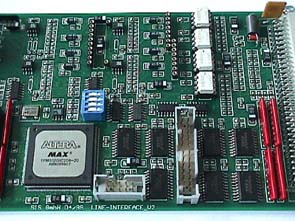
The fault detection location and the location where the actual rejection of the classified faulty item can take place is separated in many quality inspection applications. Depending on the transport mechanism, the inspected media will not necessarily be guided and or aequidistant on the conveyor. The SIS tracking and rejection system is a combination of high speed tracking electronics and a high speed kicker. The status (good/bad) is passed to the tracking electronics with fixed timing (either at the last guided position of the item under inspection, or at a fixed time relation to a tracking sensor). The second tracking sensor is mounted close to the rejection device (a high speed pneumatic pusher e.g.) and is actually controlling the rejection timing. While the inspected goods may have a speed transition between inspection and rejection, the current implementation is based on a common speed of the goods between the second tracking sensor and the rejection device. Speed variations of the conveyor can be taken into account by timing the pusher delay and the pusher out time with shaft encoder clock ticks instead of fixed time bins. Have a look at a photograph of the central portion of the printed circuit board (PCB) of the so called line interface card.

Rotary switch selectable pusher delay (fixed time bins or shaft encoder clock ticks)
Rotary switch selectable pusher out time (fixed time bins or shaft encoder clock ticks)
Speed in excess of 2000 items/minute
Optional tracking pipeline (for guided tracking portion)
Tracking pipeline (for "free running" tracking portion)
External reset
Opto coupled in/outputs
Control LEDs
Diagnosis test points
In field firmware upgrade capability
3U 19" rack mount assembly for up to 8 production lines
Stand alone single/dual line "black box" with integrated power supply
Tracking/rejection of food containers (cans e.g.)
Tracking/rejection of beverage containers (cans or bottles e.g.)
Rack mounted systems in conjunction with high speed pneumatic pushers are in field, stand alone "black box" setups according to your special requirements can be implemented on short notice. Current implementations allow for 0 to 15 containers/items between the last guided position and the tracking sensor in front ot the pusher, we plan to increase this figure to allow for a longer distance between the fault detection and the rejection device.